離開
離開 進入
進入《TAIPEI TIMES》 Opposition to unification keeps growing, poll shows
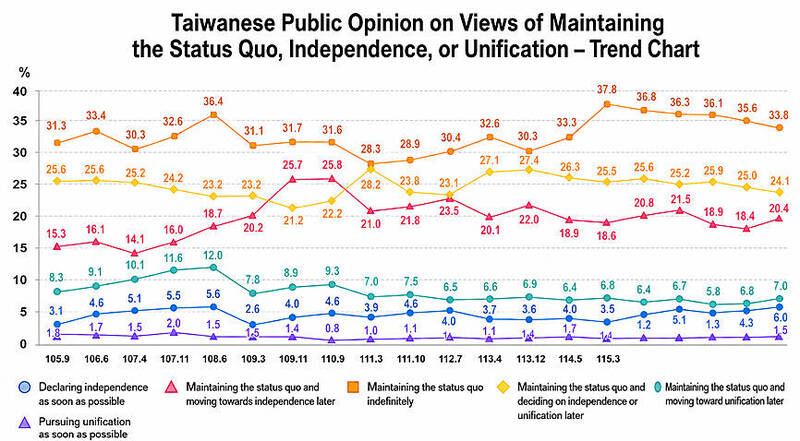
Graphic: Mainland Affairs Council
TRENDS: The survey results released by the MAC showed that support for maintaining the ‘status quo’ indefinitely had risen to 33.9%, while 61% opposed unification
By Chen Yu-fu and Fion Khan / Staff reporter, with staff writer
Despite Beijing intensifying its legal warfare against Taiwan, public opposition to unification with China has grown significantly over the past two decades, with the proportion of Taiwanese who reject unification rising to 61.7 percent this year from 39 percent in 2005, polling trends released by the Mainland Affairs Council (MAC) showed.
In addition to the “Anti-Secession” Law enacted in 2005 and the “22 guidelines to punish Taiwanese independence,” China on Wednesday last week promulgated the Ethnic Unity and Progress Promotion Law, that critics in Taiwan say aims to reinforce the false identification of Taiwanese as members of the Chinese nation.
A poll by the MAC in 2005 showed 40.5 percent of respondents supported “maintaining the ‘status quo’ and deciding on independence or unification later,” making it the most popular among the six options, while 19 percent supported “maintaining the ‘status quo’ indefinitely.”
Support for independence at the time stood at 20 percent, including 5.8 percent who favored “declaring independence as soon as possible” and 14.2 percent who favored “maintaining the ‘status quo’ and moving toward independence later,” the 2005 poll showed.
Support for unification at the time stood at 13.8 percent, including 2.7 percent who favored “pursuing unification as soon as possible” and 11.1 percent who favored “maintaining the ‘status quo’ and moving toward unification later,” the 2005 poll showed.
Those who opposed unification accounted for 39 percent in 2005, data showed.
A poll conducted by National Chengchi University’s Election Study Center, which the MAC commissioned, in March showed support for “maintaining the ‘status quo’ indefinitely” had risen to 33.9 percent, making it the most popular option among the six choices, while support for “maintaining the ‘status quo’ and deciding on independence or unification later” fell to 24.1 percent.
A total of 84.7 percent of respondents favored “maintaining the ‘status quo’ defined in a broader sense,” the poll showed.
Support for independence rose to 27.8 percent this year, including 7.4 percent who favored “declaring independence as soon as possible” and 20.4 percent who favored “maintaining the ‘status quo’ and moving toward independence later,” the poll showed.
Support for unification dropped to 7.8 percent, including 1.5 percent who favored “pursuing unification as soon as possible” and 6.3 percent who favored “maintaining the ‘status quo’ and moving toward unification later,” it showed.
Those who opposed unification rose to 61.7 percent this year, it showed.
The Election Study Center conducted a telephone survey of people aged 20 or more in Taiwan from March 19 to March 23.
It collected 1,138 valid samples, with a margin of errors of 2.91 percentage points.
The polling results showed that maintaining the “status quo” remains the mainstream position in Taiwan, while Taiwanese identity has remained strong, Tunghai University Center for Mainland China and Regional Development Research deputy director Hung Pu-chao (洪浦釗) said.
China’s “Anti-Secession” Law, the 22 guidelines and the Ethnic Unity and Progress Promotion Law have not shaken the dominant identity within Taiwanese society, he said.
However, Beijing’s legal warfare strategy is not aimed at immediately changing how Taiwanese identify themselves, but seeks to influence Taiwan’s political environment through legal measures, “united front” activities and information operations, he said.
While China cannot enforce its laws in Taiwan, it can impose entry restrictions, publicly identify targeted people, or pressure their relatives, business partners and employers, creating a form of political intimidation, he said.
The ultimate objective of China’s legal warfare is to influence people’s choices, he said.
If people reduce their public visibility, avoid expressing political views or engage in self-censorship as a result, Beijing would have already achieved part of its goal, he added.
The most alarming aspect of the new law is the potential chilling effect it could create within Taiwanese society, he said.
新聞來源:TAIPEI TIMES