離開
離開 進入
進入《TAIPEI TIMES》China’s ethnic unity law has long claws: official
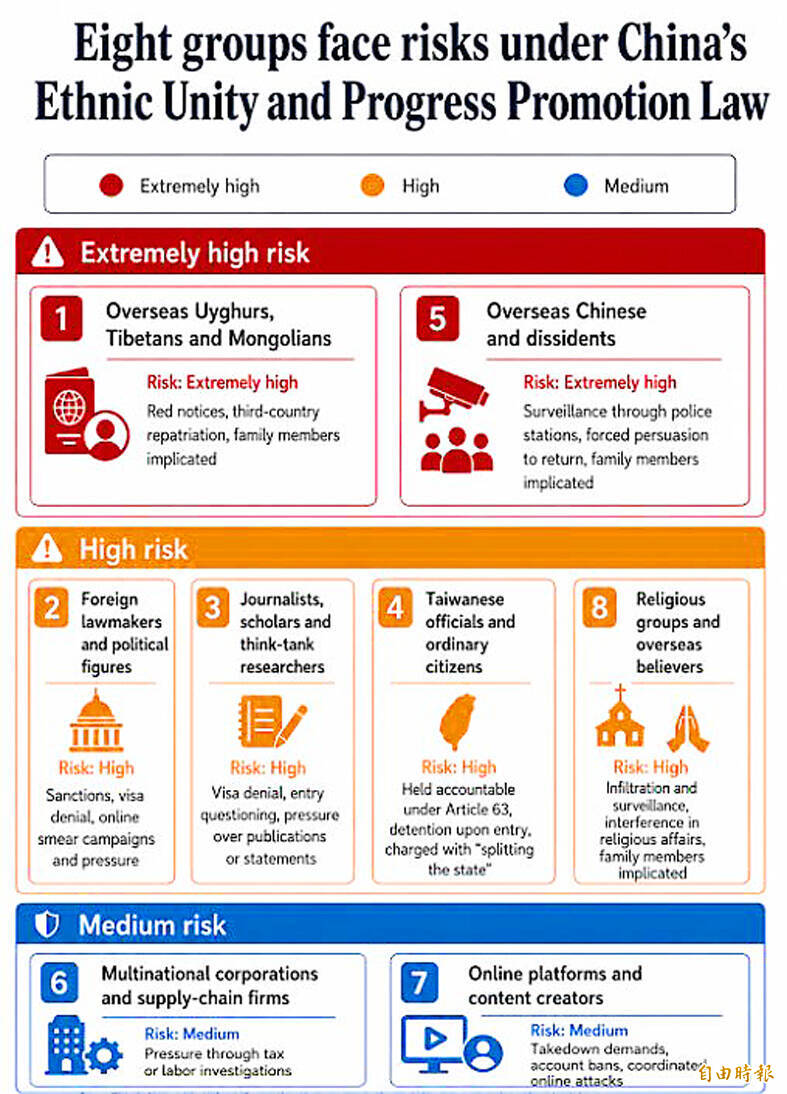
A graphic illustrates the eight groups identified by Taiwan’s national security officials as being at risk under China’s new Ethnic Unity and Progress Promotion Law. Graphic: Taipei Times
BROAD TARGET PARAMETERS:Groups the law could be used to punch down at include Taiwanese, religious sects, content creators, businesses, lawmakers and more
By Chen Yun / Staff reporter
The new “ethnic unity” law in China which took effect yesterday targets eight groups, and raises risks for Taiwanese travelers and foreign companies, a national security official said.
The “Ethnic Unity and Progress Promotion Law,” passed by the Chinese National People’s Congress in March, requires all Chinese citizens to uphold national unification and aims to reinforce the fraudulent identification of Taiwanese as members of the Chinese nation.
It said that people or organizations, whether inside or outside China, who undermine ethnic unity or promote ethnic division can be held legally liable, without saying what kind of conduct falls under those categories.
Commenting on the law, the anonymous Taiwanese official said yesterday that overseas minority groups, including Uighurs, Tibetans and Mongolians, could face “red notices,” extradition from third countries, or retaliation against family members in China if Beijing determines their overseas activities amount to separatism.
Overseas Chinese and political dissidents are at risk, the official said, adding that anyone who continues to speak out about China’s government or human rights record could come under pressure through overseas law enforcement outposts and other forms of transnational harassment.
Foreign lawmakers and political figures could face online smear campaigns, pressure, sanctions or visa denials as part of efforts to silence criticism, they added, adding that the law provides Beijing with broader domestic legal backing for its authoritarian practices, granting a form of state-sanctioned legitimacy.
Journalists, academics and think tank researchers are at risk, the official said, adding that those who write about China’s human rights record, military expansion, or its treatment of Taiwan could face intense scrutiny at the border, pressure or restrictions on their ability to publish.
Under Article 63 of the law, which allows for extraterritorial liability, Taiwanese officials and ordinary citizens could face the risk of being detained without warning or charged with separatism when entering or transiting through China, or other closely aligned non-democratic countries, the official said.
They said that religious groups long targeted by Beijing, such as Taiwan’s I-Kuan Tao (一貫道) — which China classifies as a “heterodox sect” — could face transnational repression, including pressure on overseas followers and members.
The law could place particular pressure on international companies working with democratic partners, the official said.
Firms that promote non-China supply chains, participate in export controls on China or carry out forced-labor investigations into Chinese products could face sanctions, they said.
They added the law could be used to pressure online platforms and content creators, with authorities able to demand the removal of content deemed contrary to China’s national interests or ethnic unity.
Creators could face risks including account suspensions and coordinated online harassment, they said.
Two years ago China introduced regulations authorizing its Ministry of State Security to inspect people’s mobile phones, computers and social media accounts.
The official said that under these rules, a wide range of people, including overseas minorities, political dissidents, foreign lawmakers and politicians, multinational companies and supply chain firms, online content creators, and ordinary travelers, could face detention and be prevented from leaving the country.
Anyone entering or transiting through China could be detained if found to have shared or supported content deemed criminal by Beijing, or even to have had contact with dissidents, they said.
Additional reporting by CNA
新聞來源:TAIPEI TIMES