離開
離開 進入
進入《TAIPEI TIMES》 Spy case involves combat-capable unit leaks: source
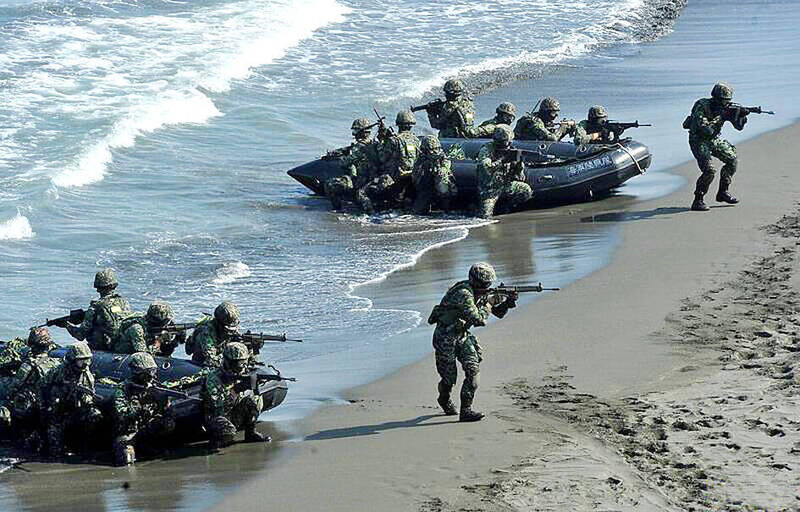
The army’s 99th Brigade carries out a beach landing mission using inflatable boats during a drill in an undated photograph. Photo: Taipei Times
By Wu Sheng-ju and William Hetherington / Staff reporter, with staff writer
An espionage case involving a TV reporter allegedly included leaked classified documents regarding the 333rd, 66th and 99th brigades — among the military’s most combat-capable units, a military source said yesterday.
CTi News reporter Lin Chen-yu (林宸佑) was indicted last month on charges of contravening the Anti-Infiltration Act (反滲透法) and national security laws, as well as corruption.
Lin allegedly received cryptocurrency from overseas actors, produced videos critical of the mass recall campaign targeting opposition lawmakers, and recruited six current and former military personnel to record pro-China videos and gather military intelligence, prosecutors said.
Those implicated include a noncommissioned officer responsible for managing army documents, a soldier from a helicopter unit, personnel from a multiple-launch rocket system unit, a noncommissioned marine corps officer from the 66th Brigade and an officer from the army’s 333rd Mechanized Infantry Brigade, they said.
The source, a field-grade officer familiar with the case, said many of the military personnel allegedly recruited by overseas actors had sought financial assistance online and were targeted because they had debt, most of which was gambling-related.
Fearing that their financial problems would be exposed and damage to their military careers, some allegedly agreed to provide classified information in exchange for money, the source said.
The alleged leaked materials suggest intelligence-gathering efforts were focused on units with strong combat capabilities, including the 66th and 99th brigades (the marine corps formations), and the army’s 333rd Mechanized Infantry Brigade. The latter, once referred to as the military’s “premier division,” has conducted training and exercises with US forces for years and remains a capable combat unit despite organizational restructuring.
Legal experts said Taiwan should consider tougher penalties to deter similar cases and protect national security, with some calling for expanded use of severe punishments under the Armed Forces Penal Code (陸海空軍刑法).
Foreign forces have long used political, business and religious exchanges as a cover to gather intelligence and have increasingly sought to infiltrate the military, a prosecutor said.
No active-duty service member has been sentenced to death or life imprisonment for selling military secrets since the end of martial law, raising questions over whether existing penalties are sufficient to deter such offenses.
The National Security Act (國家安全法), Anti-Infiltration Act and Classified National Security Information Protection Act (國家機密保護法) form the main legal framework for such cases, Minglun Law Firm managing attorney Fang Yen-hui (房彥輝) said.
The most severe penalties under the National Security Act apply to those who act under the direction of, or develop organizations for, hostile foreign forces, he said, adding that the minimum prison term is at least seven years.
The Armed Forces Penal Code allows for life imprisonment or the death penalty for active-duty personnel who engage in espionage, assist spies, provide military advantage to an enemy or disclose military secrets, Fang said.
However, these provisions generally apply only to active-duty personnel or civilians during wartime, he added.
Lawmakers should consider tougher penalties for breaking national security laws or broadening the scope of the Armed Forces Penal Code to better deter leaks of military secrets, such as operational plans, weapons deployments and identities of intelligence personnel.
新聞來源:TAIPEI TIMES