離開
離開 進入
進入《TAIPEI TIMES》First case of AI glass cheating caught in NTU entrance exams
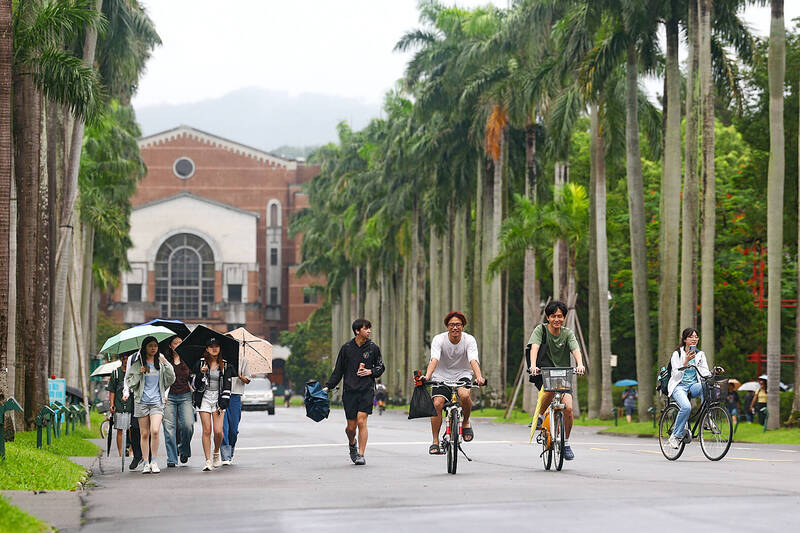
People walk and ride on Royal Palm Boulevard at National Taiwan University in Taipei yesterday. Photo: CNA
By Yang Mien-chieh and Jonathan Chin / Staff reporter, with staff writer
National Taiwan University (NTU) yesterday said it disqualified a person from an entrance examination for using AI smart glasses to cheat, along with two others for making untruthful statements in their curriculum vitae.
The three applicants were given null scores, Taiwan’s highest-ranked university said, calling on prospective students to be honest in the admissions process.
NTU registrar Lee Hung-sen (李宏森) said that the cheating applicant wore a hat and thick-rimmed glasses to the second written exam for medical school, claiming that they felt cold.
Suspicions were aroused when the applicant stared oddly at the test for long stretches while steadily bringing the paper closer, Lee said.
Test supervisors examined the applicant’s glasses and found that the oversized frame concealed a pair of smart glasses, which were “piping hot” from use, he said.
The two others were applicants to the electronic engineering department who had placed second and third in the national selection process for Science Olympiad contestants, he said.
The two neglected to specify that their awards were for the selection process, not the event itself, Lee said, adding that many NTU professors were advisers of other contestants.
As anyone placing top three in the Science Olympiad would have had a guaranteed spot in the department, professors evaluating the applications double-checked the records and discovered the deception, Lee said.
The university has reported the attempt to use AI smart glasses to cheat to the College Entrance Examination Center, which has revised its testing protocols as a result, he said.
Test-takers should know that NTU has rigorous anti-cheating measures, while students are asked to verify information provided by artificial intelligence (AI) by using properly cited sources, he said.
NTU had 1,789 places for new students, 14,019 applicants and 13,831 admittances this year, leaving slots for 188 students unfilled, university officials said.
In related news, the College Admissions Committee yesterday said Taiwanese institutions of higher learning accepted 44,082 applications, or 56.31 percent of total applicants, filling 84.5 percent of available placements.
The figures are historical highs, but the total number of applicants this year was 78,280, fewer than the 91,001 applicants last year, the committee said.
This year’s available placements for new students was 50,450, down from 50,854 last year, it said.
This year’s number of unfilled quotas for students was 7,823, a five-year low, it said.
The data do not include guaranteed spots for applicants of indigenous descent, applicants from outlying islands or those from disadvantaged backgrounds selected by the National University Vision Plan.
Tamkang University, Ming Chuan University and National Chiayi University had the highest unfilled slots among institutions nationwide in that order, the committee said.
Earth science departments filled 92.69 percent of available spots, the highest figure for the metric among academic disciplines, it said.
Engineering departments and information science departments filled 92.55 and 90 percent of available spots, second and third-highest respectively, it said.
Foreign-language departments, law and political science departments, and humanities used 70.96 percent, 72.95 percent and 73.41 percent respectively of available placements, the lowest rates among disciplines, the committee said.
Medical schools admitted 597 new students out of 4,918 applicants, but only 460 went through with their applications, a recruitment shortfall of 137 students, it said.
That was the highest number of unfilled slots in medical sciences in five years, likely reflecting competition for talent from AI-related fields, the committee said.
新聞來源:TAIPEI TIMES