離開
離開 進入
進入《TAIPEI TIMES》 Labor ministry defends plan for Indian workers
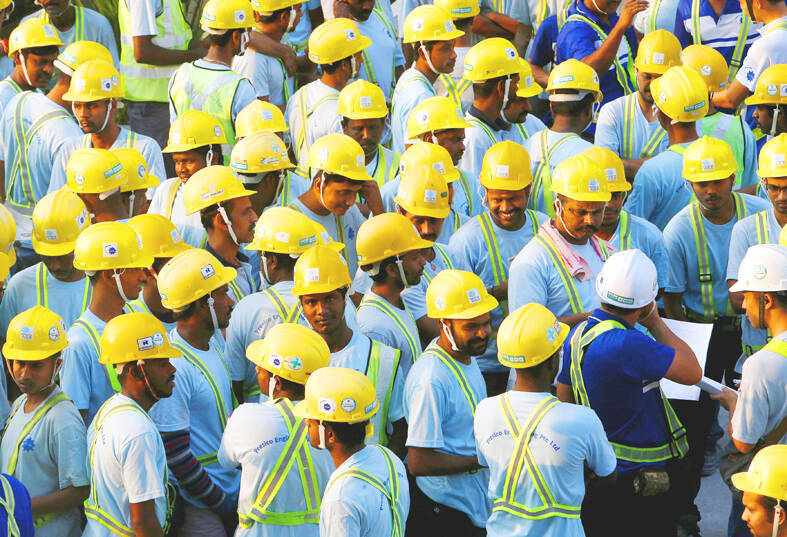
Construction workers from Bangladesh and India attend a briefing before starting work at a construction site in Singapore on March 24, 2016. Photo: Reuters
UNFOUNDED CONCERNS: Public concerns that allowing Indian workers to come and work in Taiwan would lead to increased sex crimes are baseless, the labor ministry said
By Lee Ching-hui / Staff reporter
Amid public concern over the government’s plan to bring Indian workers to Taiwan, the Ministry of Labor (MOL) pointed to past intake and said that public safety remained stable.
Minister of Labor Hung Sun-han (洪申翰) on April 9 told the legislature that the first group of Indian workers could arrive as early as the end of this year.
Taiwan and India signed a memorandum of understanding (MOU) in February 2024 to address Taiwan’s labor shortage. The MOU was sent to the Legislative Yuan for review in mid-2024 and received cross-party backing, prompting the MOL to begin follow-up negotiations with India, Hung said.
Public concern has subsequently surfaced, with a petition launched on the National Development Council’s public policy participation platform. The petition calls for a halt to the plan and referenced fears among some in Taiwan about the risk of Indian workers comitting sexual violence.
Some others argued that Taiwan already faces serious issues with undocumented migrant workers and should not expand labor sources without first addressing those problems.
Latest data from the MOL showed that, as of the end of March, there were approximately 873,000 migrant workers in Taiwan. Indonesians accounted for the largest share at 37.3 percent, followed by Vietnamese at 33.7 percent. In the manufacturing sector, 40 percent of migrant workers are from Vietnam, while in social welfare positions, such as domestic caregivers, as many as 70 percent are Indonesian workers.
The MOL said that, in addition to Taiwan’s irreversible trends of an aging population and declining birthrate, the labor shortage crisis would continue to grow each year. Compared with countries like Japan, South Korea and Singapore, which each have migrant workers from more than 10 different source countries, Taiwan relies on just four — Thailand, the Philippines, Vietnam and Indonesia, it said.
If any of these countries were to temporarily halt labor exports due to policy or international developments, it would create a “labor shortage national security crisis” for Taiwan’s industries and care systems, it said.
Expanding Taiwan’s sources of migrant workers is intended to give employers “more options,” but the choice of which country to hire from would remain up to them, it said, adding the recruitment process still follows a “nationals first” principle, requiring employers to attempt to hire local workers before applying for migrant labor. Migrant workers are meant to fill gaps in physically demanding, dirty or dangerous jobs in manufacturing, construction and agriculture, without opening new industries to migrant labor, it said
The government would start with a small-scale pilot of about 1,000 workers, with future expansion dependent on its success, it added.
Concerns that bringing in Indian migrant workers could lead to more sex crimes or a strain on Taiwan’s labor and health insurance systems are unfounded, the MOL said.
Experience from Japan and Singapore show that public safety did not deteriorate after recruiting Indian workers, it said, adding that a recent survey in Japan even ranked Indian workers as the third most welcomed group among foreign laborers.
All recruits must provide a “certificate of good conduct” from the Indian government and pass Taiwan’s strict screening process, the MOL said.
It also said that migrant workers are “net contributors” to the insurance system as they are young, stay only temporarily, rarely use health services and most return home before collecting pensions.
Additional reporting by CNA
新聞來源:TAIPEI TIMES