離開
離開 進入
進入《TAIPEI TIMES》 Foreign exchange reserves fall below US$600 billion
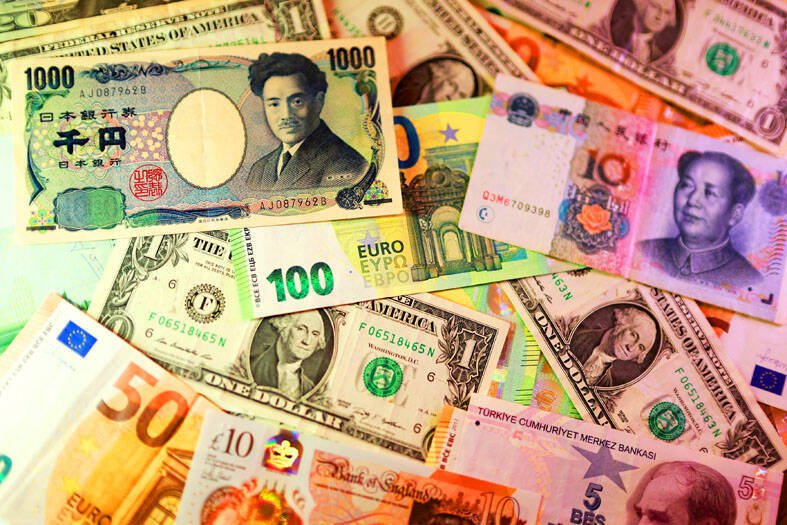
US dollar, euro, yen, pound, Turkish lira and yuan banknotes are pictured on March 24. Photo: Reuters
By Crystal Hsu / Staff reporter
Taiwan’s foreign exchange reserves fell below the US$600 billion mark at the end of last month, with the central bank reporting a total of US$596.89 billion — a decline of US$8.6 billion from February — ending a three-month streak of increases.
The central bank attributed the drop to a combination of factors such as outflows by foreign institutional investors, currency fluctuations and its own market interventions.
“The large-scale outflows disrupted the balance of supply and demand in the foreign exchange market, prompting the central bank to intervene repeatedly by selling US dollars to stabilize the local currency,” Department of Foreign Exchange Director-General Eugene Tsai (蔡炯民) said.
The interventions were the main factor behind the monthly drop in foreign exchange reserves, he said.
Last month saw significant capital outflows, with about US$24 billion leaving Taiwan, as institutional investors seek refuge in the US dollar amid intensifying tensions in the Middle East.
Meanwhile, a stronger US dollar led to broader swings in major currencies, affecting the valuation of Taiwan’s holdings, Tsai said.
Investment returns contributed little to the reserves, with most interest income scheduled for recognition this month, he said.
Despite the decline, the central bank said the reduction was not unusually large.
During the 2008 global financial crisis and the 2009 European sovereign debt crisis, Taiwan’s reserves fell by more than US$10 billion in a single month, Tsai said.
Taiwan’s external position remains solid, Tsai said.
Exporters continue to hold ample US-dollar funds, while the country’s persistent current-account surplus should provide a stable source of foreign exchange inflows, he added.
Globally, China remains the largest holder of foreign exchange reserves at US$3.4 trillion, followed by Japan with US$1.16 trillion. Other major holders include Switzerland, India, Saudi Arabia, Hong Kong and South Korea.
新聞來源:TAIPEI TIMES