離開
離開 進入
進入《TAIPEI TIMES》 Fall of top general stirs uncertainty regarding China
2026/01/30 03:00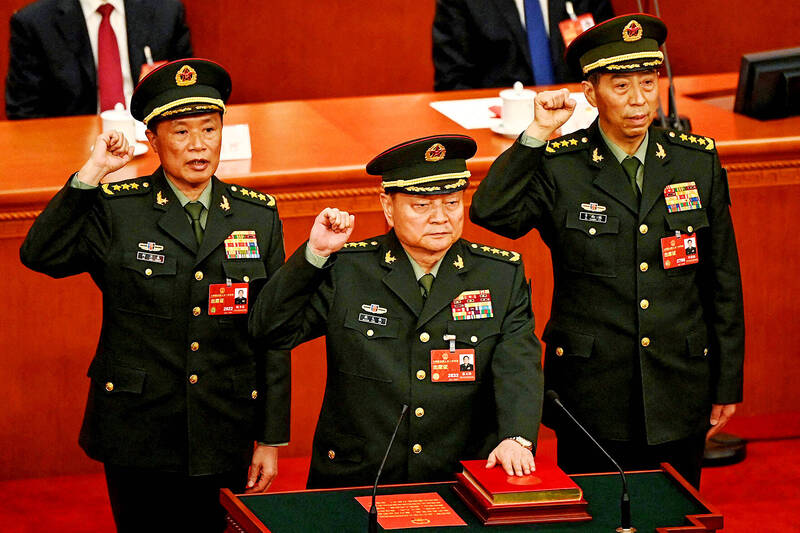
Former Chinese Central Military Commission vice chairman Zhang Youxia, center, swears an oath at the Great Hall of the People in Beijing on March 11, 2023. Photo: AFP
SUPRISING ANNOUNCEMENT:Zhang Youxia’s demise removes a respected figure from the PLA, with a former US Air Force general saying China lost a voice of reason
/ Staff writer, with agencies
Washington is closely watching developments in China after it removed a top general, US Secretary of State Marco Rubio said on Wednesday, as Beijing indicated that the anti-graft purge would not impede its plans for eventually taking control of Taiwan.
The Chinese Ministry of National Defense on Saturday announced that Zhang Youxia (張又俠), second-in-command under Chinese President Xi Jinping (習近平) as vice chairman of the Central Military Commission (CMC), is under investigation.
It was the latest high-profile military leadership purge amid Xi’s crackdown on corruption.
The firing was “part of a pattern we’ve seen over the last few years, which is a purge in their military,” Rubio told the US Senate Foreign Relations Committee.
“They’re spending a lot of money on their military and obviously some of these guys are stealing that money and they’re trying to address that,” he said. “It’s an issue internally in their system. They’re obviously not sharing with us or talking to us in depth about any of that, but it’s certainly something we watch with interest.”
While questioned whether Trump’s policies in Venezuela and their potential for encouraging moves by China against Taiwan and Russia even more so in Ukraine, Rubio said China’s stated goal to reunify Taiwan with the mainland would not be affected by any other world event, including the Maduro operation.
“The situation on Taiwan is a legacy project" that Chinese President Xi Jinping has made "very clear that that’s what he intends to do and that’s going to be irrespective anything that happens in the world,” Rubio said.
Ministry spokesman Jiang Bin (蔣斌) said that while “peaceful reunification” is China’s guiding principle, “we never renounce the use of force in resolving the Taiwan question, and the Chinese People’s Liberation Army [PLA] will never allow anyone to separate Taiwan from its motherland.”
“Eventually China will be reunified,” he added.
“The harder the people’s military fights against corruption, the stronger, purer and more combat effective it becomes.” Jiang said. “We will always be a heroic force that the party can trust and the people can rely on.”
Analysts said that with the downfall of China’s top general, Beijing’s Taiwan ambitions seem to be in disarray, while the US has lost an important contact and now faces a PLA that increasingly lacked steadiness.
The announcement was “a bombshell, with a far-reaching and profound impact,” Beijing-based independent analyst Hua Po (華頗) said.
SOAS China Institute director Steve Tsang (曾銳生) said that “sacking him [Zhang] means that no other general in the PLA can feel safe now.”
CMC replacements “will be yes men who will not dare to challenge Xi,” he added.
Following the shake-up, most experts said that a full-on invasion of Taiwan seemed unlikely in the short term.
“It just makes it even riskier than it already is, if you don’t have a series of experienced commanders who have worked with each other in complex joint operations, which now China absolutely does not have,” Asia Society fellow Neil Thomas said.
Institute for Security and Development Policy director Niklas Swanstrom said that it complicated matters further, as “the purged generals ... are seen as the ones with the most knowledge and experience in preparing for a Taiwan operation.”
When it comes to an invasion, the PLA is “still hampered by the limited number of amphibious combined arms brigades” it has, Nanyang Technological University assistant professor James Char (夏爾) said, while Institute for National Defense and Security Research research fellow Su Tzu-yun (蘇紫雲) said a failed attack would be a “political catastrophe” for Xi.
“Consolidating control at home ... appears to be the more rational course of action for Xi than launching a war whose outcome cannot be assured,” Su said.
For Washington, Zhang’s surprising demise removes a respected and well-known figure within China’s military at a time when successive US administrations have worked to build senior-level contacts with Beijing to avoid mishaps between the world’s two most powerful militaries.
Several former senior US officials said that Zhang’s dismissal came as a shock.
Xi allowed Zhang to communicate with the US during former US president Joe Biden’s administration after China cut off nearly all military communications for 17 months following a visit to Taiwan by then-US House of Representatives speaker Nancy Pelosi.
Such a senior-level connection — in China’s political system, Zhang outranks the minister of defense — was seen as an important relationship and a channel that remained viable for further talks.
One of just a few leading officers with combat experience from China’s invasion of Vietnam in the late 1970s, Zhang was seen in the US as a competent adviser to Xi, who sits atop the CMC, which is now staffed by only one general — career political commissar Zhang Shengmin (張升民).
“Who does Xi Jinping convene in a crisis if there’s only one person on his commission?” said S. Rajaratnam School of International Studies in Singapore senior fellow Drew Thompson, who engaged with Zhang Youxia when he was a US defense official.
Thompson said he believed Zhang Youxia was the one active-duty PLA officer who could give Xi objective advice about China’s military capabilities and shortcomings, as well as the human cost of conflict.
“There’s a risk that Xi Jinping is given bad advice by sycophants who tell him what he wants to hear,” he said. “That creates a risk of miscalculation.”
A senior US administration official said the White House had nothing to share regarding “reports of palace intrigue” in China, adding that US President Donald Trump’s administration is “building a military capable of denying aggression anywhere in the first island chain.”
The Pentagon did not respond to a request for comment, and the Chinese embassy in Washington did not respond.
US Secretary of Defense Pete Hegseth has held multiple talks with Chinese Minister of National Defense Dong Jun (董軍) — who does not sit on the CMC — since September last year as part of US efforts to improve communications with China over its military modernization, nuclear weapons build-up, and more aggressive posture toward US allies and actions in the Indo-Pacific region.
However, US officials have long prized contact with vice chairs of the CMC over China’s defense ministry, which lacks command authority over its armed forces.
Among senior Chinese generals, Zhang Youxia was a known figure to US officials, having joined a week-long military delegation to the US in May 2012 when he was a lower-level general.
David Stilwell, a former US Air Force general who served as the US Department of State’s top diplomat for East Asia during Trump’s first term, said that Zhang Youxia was the only Chinese officer who wanted to fly in one of the US military’s Osprey aircraft on that trip.
“He is very different from his fellow PLA brothers. He could have fit in very well in the US military,” Stilwell said, adding that he was keen to talk to US soldiers and try out US weapons, and struck them as a professional, rather than political soldier.
Still, Stilwell said senior-level engagement with CMC generals was typically perfunctory.
Without Zhang Youxia to advise Xi, his main concern was that the PLA was more likely to believe a self-constructed narrative that they were ready for a “Taiwan adventure.”
“I think what you lose with Zhang Youxia gone is a voice of reason,” Stilwell said.
新聞來源:TAIPEI TIMES