離開
離開 進入
進入《TAIPEI TIMES》 Kids’ seaweed products recalled
2026/01/14 03:00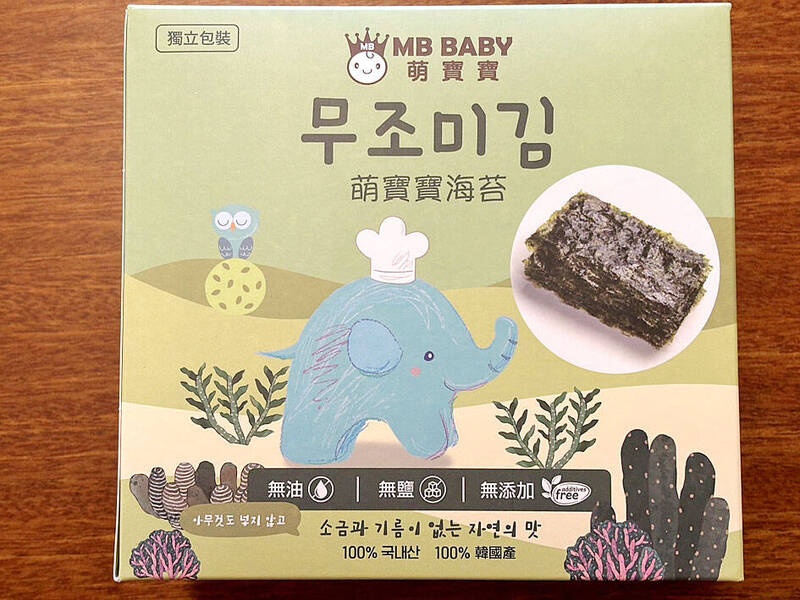
An MB BABY seaweed product is pictured in a photograph released by the Food and Drug Administration yesterday. Photo courtesy of the Food and Drug Administration
HEAVY METALS ISSUE: Six seaweed products had lead levels up to 4 times the maximum allowable and cadmium levels up to 50 times the limit, the FDA said
By Lee I-chia / Staff reporter
Tests of six seaweed products marketed toward young children and infants showed that they contained lead and cadmium in excess of legal limits, the Food and Drug Administration (FDA) said yesterday, advising parents to not give them to their children.
Chinese-language Mirror Media magazine last week reported that it had received a tip-off that seaweed products imported from South Korea or made in Taiwan with ingredients imported from South Korea allegedly had excessive amounts of the heavy metals, but were still on the shelves.
The magazine said it purchased seven of the products and submitted them to SGS SA, an inspection, verification, testing and certification company, which reported that all of them contained heavy metals exceeding legal limits.
The products had lead levels 1.4 to 4.4 times the limit and cadmium levels 22 to 53 times the limit, the magazine reported.
The FDA yesterday said that it and local health departments conducted random inspections on six of the seven products reported by the magazine, with one product sold out.
All six products failed to meet the maximum allowable limits for lead and cadmium as stipulated in Annex Table 1 of the Sanitation Standards for Contaminants and Toxins in Foods (食品中污染物質及毒素衛生標準), the FDA said.
The annex says the maximum level for cadmium in supplementary baby food is 0.04 milligrams per kilogram (mg/kg), while the general standard for seaweed is 1mg/kg on a wet weight basis.
The standards for lead are 0.05mg/kg and 1mg/kg respectively.
The companies supplying the six products — BEBE Kids’ Crispy Seaweed (BEBE 貝兒純淨海苔), LUSOL Unsalted and Unflavored Baked Seaweed (LUSOL 無鹽無調味烘烤海苔), YummyBaby 100% Pure Olive Oil Seaweed (芽米寶貝100%純橄欖油海苔), MB BABY Seaweed (MB BABY 萌寶寶海苔), HanAbbaDiary Kids’ Seaweed (韓爸田園日記嚴選初收孩苔) and Ibobomi Unflavored Kids’ Crispy Seaweed (Ibobomi 無調味海苔片) — have been ordered to recall them and remove them from the shelves, with 25,047 items removed as of Monday, the FDA said.
People who have purchased any of the six products should not eat them and can contact the retailer for a refund, it said.
The sold-out product tested in the magazine report, but not by the FDA, was Naeiae Organic Roasted Seaweed (Naeiae 韓國幼兒紫菜).
Testing showed that the six products had lead levels ranging from 0.14mg/kg to 0.206mg/kg and cadmium levels from 0.912mg/kg to 2.013mg/kg, said Liu Fang-ming (劉芳銘), director of the FDA’s Northern Taiwan Management Center.
MB BABY Seaweed had lead levels of 0.206mg/kg, about four times the allowable limit, while HanAbbaDiary Kids’ Seaweed had chromium levels of 2.013mg/kg, or about 50 times the allowable limit, Liu said.
Starting last week, the FDA listed imported seaweed products for young children and infants under “monitoring inspection” until Feb. 6, meaning they would be subject to batch-by-batch testing for heavy metals, he said, adding that adjustments to the inspection regime would be made according to the results of the testing.
Meanwhile, the FDA would reference regulations in other countries as it considers requiring food companies to label products as “infant food” if they are marketed as for children up to three years old so consumers could easily identify products that are subject to stricter food standards, Liu said.
新聞來源:TAIPEI TIMES