離開
離開 進入
進入《TAIPEI TIMES》 DPP proposes changes to anti-spying laws
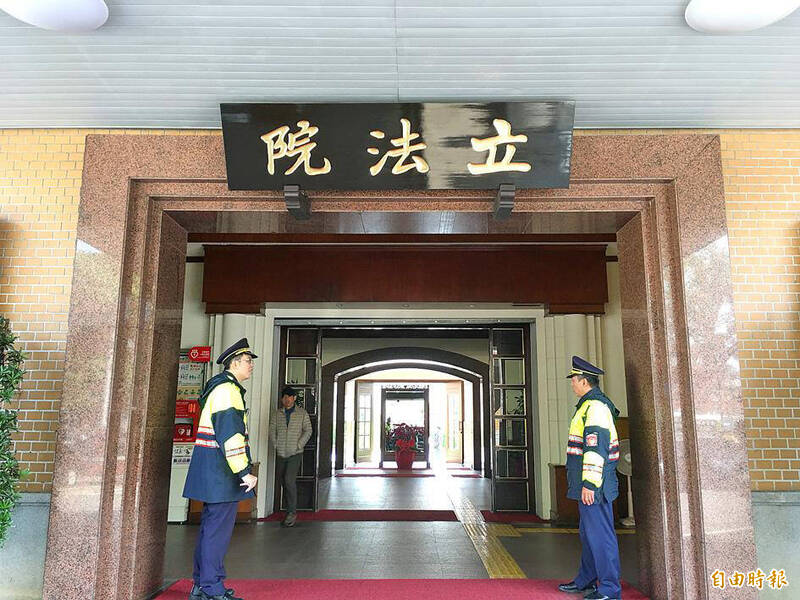
Police officers guard the entrance to the Legislative Yuan in Taipei in an undated photograph. Photo: Lin Liang-sheng, Taipei Times
INFILTRATION: There is a clear distinction between exercising the personal right to free speech and being paid by the CCP to spread propaganda, Wang Ting-yu said
By Hsieh Chun-lin and Fion Khan / Staff reporter, with staff writer
Democratic Progressive Party legislators Wang Ting-yu (王定宇) and Wang Yi-chuan (王義川) have proposed amendments to the Anti-infiltration Act (反滲透法) to prevent the Chinese Communist Party (CCP) from undermining democracy in Taiwan by conducting “united front” propaganda under the guise of freedom of speech.
The proposal to amend Article 5 of the act prohibits people from accepting instructions, commissions or funding from infiltration sources to engage in activities that cooperate with “united front” work or carry out politically motivated propaganda.
According to the draft, those who contravene the act would be fined between NT$100,000 and NT$500,000 (US$3,184 and US$15,919), with related materials to be confiscated.
The draft also proposed that anyone who contravenes the aforementioned provisions by raising, hanging, displaying, holding, or waving the flags or symbols of foreign hostile forces, or their party, government or military in public places would be fined between NT$50,000 and NT$300,000, with related items to be confiscated.
However, it would not apply to conferences or activities approved by the competent authority or to actions carried out in accordance with international treaties or conventions, according to the bill.
The proposal was sent to a legislative committee for review on Friday.
China is good at using local Taiwanese collaborators to blur the line between friend and foe, and engage in actions that aid the enemy, while disguising their behavior as legitimate expressions of Taiwanese political identity, the lawmakers said.
Whether such expression of political identity falls under the constitutional protection of freedom of speech is disputed, they said.
Local collaborators have become tools manipulated and controlled by China to sabotage the nation’s democratic system, meaning they are not entitled to constitutional free speech protections, they said.
China’s cognitive warfare against Taiwan has intensified, with Beijing operating a “central kitchen” to push specific political agendas, Wang Ting-yu said yesterday.
Local collaborators and information companies hired for such purpose deploy large numbers of online trolls to steer public opinion in Taiwan, he added.
The content promoted by such actors almost perfectly mirrors the political agenda being advanced by the CCP, he said.
The CCP is exploiting Taiwan’s open society and freedom of speech in an attempt to destroy that freedom by using distortion and orchestrated campaigns to drown out legitimate voices, Wang Ting-yu said.
It has happened before, but the situation has become much worse, he said.
The proposed legislative amendments are not intended to restrict freedom of expression, he added.
“It is fine if you want to say something on your own. However, if you are taking money from the CCP or accepting commissions from the Chinese government, military or affiliated organizations, then we believe there should be legal consequences,” he said.
There is a clear distinction between exercising personal free speech and being paid by the CCP to spread its propaganda, Wang Ting-yu said.
Meanwhile, the two lawmakers have also proposed amendments to the Lobbying Act (遊說法) to prohibit people from China, Hong Kong or Macau from lobbying.
The draft would impose fines of up to NT$5 million for those who contravene the act, with the same penalties applying to those who knowingly accept such lobbying or deliberately conceal it.
The bill was also sent to a legislative committee for review on Friday last week.
Article 7 of the act currently prohibits foreign governments, legal persons, organizations and natural persons from lobbying matters related to national defense, foreign affairs and mainland affairs concerned with national security or national secrets, while the same applies to people and organizations from China, Hong Kong and Macau, they said.
Without corresponding penalties, the law is toothless, they said.
The draft amendment would introduce fines ranging from NT$500,000 to NT$2.5 million for contraventions of rules, with the same penalties applying to those who fail to refuse illegal lobbying attempts.
It also proposed to amend Article 8 of the act by adding references to “foreign hostile forces” and “people dispatched or acting on their behalf,” in accordance with amendments to the Criminal Code, the National Security Act (國家安全法) and the Classified National Security Information Protection Act (國家機密保護法).
The draft stipulates that people or organizations from China, Hong Kong, Macau, foreign forces or people acting on their behalf shall not engage in lobbying themselves or commission others to do so.
Those who contravene the act would be fined NT$1 million to NT$5 million, with the same penalties applying to those who accept such lobbying or intentionally conceal violations.
新聞來源:TAIPEI TIMES