離開
離開 進入
進入《TAIPEI TIMES》 Currency claim by ‘The Economist’ sparks pushback
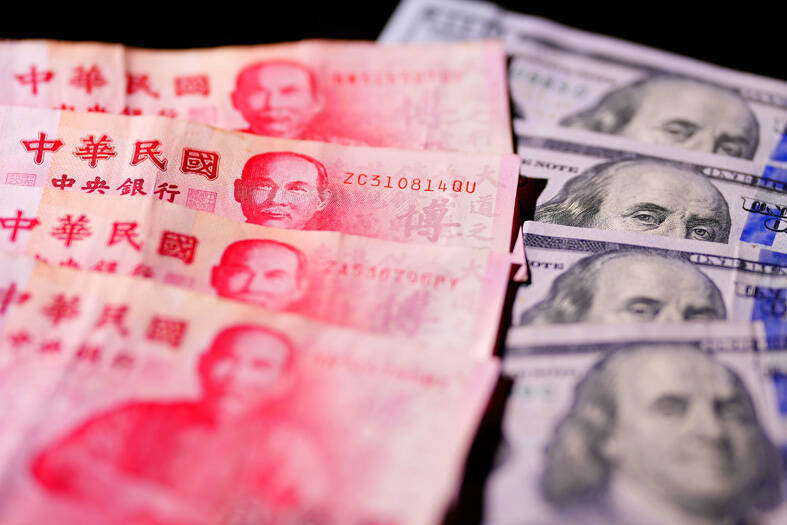
New Taiwan dollar, left, and US dollar banknotes are pictured in Taipei on Monday last week. Photo: CNA
BACKLASH: Taiwan’s strong export performance is driven by AI, Kung Ming-hsin said, adding: ‘We are not sick. It is those who make such claims who are sick’
/ Staff writer, with CNA
A recent article in The Economist arguing that the central bank has long kept the New Taiwan dollar undervalued has sparked debate among officials and academics, who say the analysis overlooks major shifts in Taiwan’s industrial structure.
The magazine used its Big Mac Index to claim the central bank’s currency policy has weakened purchasing power, driven up housing prices and created financial risks — a view that National Development Council (NDC) Minister Yeh Chun-hsien (葉俊顯) said fails to reflect how Taiwan’s export mix has changed over the past 30 to 40 years.
Yeh on Wednesday said that Taiwan’s industries were once dominated by traditional manufacturing, but the rise of semiconductors and upgraded conventional sectors means firms with unique products or technologies are no longer as vulnerable to exchange rate swings.
Minister of Economic Affairs Kung Ming-hsin (龔明鑫) said that Taiwan’s strong export performance has been driven by artificial intelligence (AI) demand, not currency manipulation.
“We are not sick. It is those who make such claims who are sick,” he said on Thursday.
Debates over the exchange rate are not new. From 2008 to 2013, exporters frequently urged the central bank to weaken the NT dollar, including then-Taiwan Semiconductor Manufacturing Co (TSMC, 台積電) chairman Morris Chang (張忠謀), who openly clashed with then-central bank governor Perng Fai-nan (彭淮南). Chang at the time criticized Taiwan’s stronger currency compared with South Korea’s, saying cost pressures were hurting competitiveness. Perng countered that exchange rates cannot solve all export problems.
At the time, South Korea was clearly using depreciation to support its industries, National Central University economist Chiou Jiunn-rong (邱俊榮) said, adding that TSMC was not the global leader it is today and was more sensitive to margin pressures.
Taiwan’s central bank has generally maintained a “dynamic balance,” keeping the currency slightly weaker, but avoiding aggressive intervention, Chiou said.
Still, criticism has persisted from various sectors, he said.
With TSMC now dominant in advanced manufacturing, the calls for depreciation have subsided, and most businesses now prefer exchange rate stability over rapid swings, Chiou added.
Today’s challenges — from trade protectionism and US-China tensions to geopolitical risks — are far more complex than a decade ago, he said.
While AI has boosted Taiwan’s resilience, traditional industries face pressure mainly from China’s overcapacity and weak demand, with exchange rates only worsening an already difficult situation, he added.
Global political and economic shifts — including tariff battles, trade negotiations and new carbon costs — have made the old low-cost model harder to sustain, Chiou said.
Meanwhile, US scrutiny of currency manipulation limits how far Taiwan can intervene, which could be an opportunity to move toward a more flexible, stable approach, he added.
新聞來源:TAIPEI TIMES