離開
離開 進入
進入《TAIPEI TIMES》 Sanctions a key part of deterring China: US report
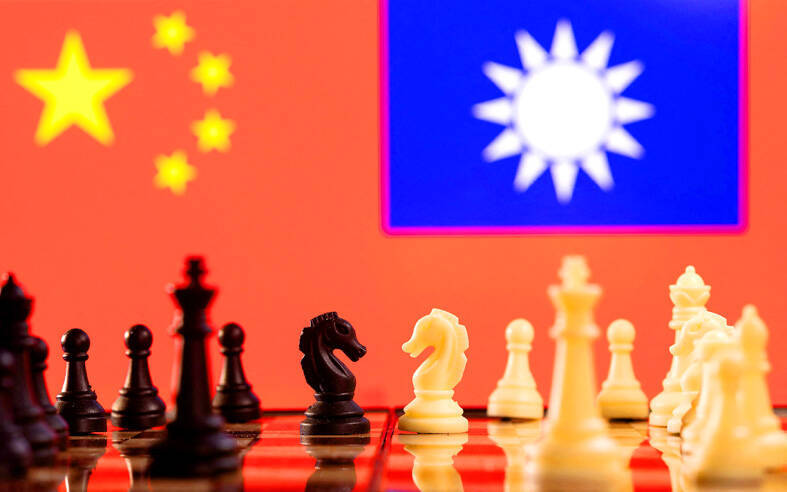
Chess pieces are pictured in front of a Taiwanese flag, right, and a Chinese flag on Jan. 25, 2022. Photo: Reuters
SENDING A MESSAGE:Allies must signal to China that taking Taiwan would be a difficult fight and that it would emerge substantially weaker, the US report said
By William Hetherington / Staff writer, with CNA
Economic measures such as sanctions would serve as key elements in a broader toolkit to deter Chinese aggression, a report by the US-based RAND Corp published earlier this month said.
The report, titled Economic Deterrence in a China Contingency, said deterring a Chinese attack on Taiwan is at the core of security planning by Washington and its allies. Sanctions — while a key part of that strategy — should be combined with diplomatic and military instruments, and backed up by allies to maximize effectiveness, it said.
“Japan has the technical ability to impose sanctions relatively quickly, but the political decision would be difficult,” the report said.
The report was published a day before Japanese Prime Minister Sanae Takaichi’s comments, which started an ongoing row with China.
Takaichi on Nov. 7 said that if an emergency involving Taiwan were to occur alongside the use of force, it could constitute a “survival-threatening situation” under Japanese law, one which allows Japan to exercise its right of collective self-defense.
The report examined scenarios of a Chinese blockade or invasion of Taiwan within the next three to six months, and discusses what economic actions the US, Australia, Japan and the UK could take to deter such aggression, as well as what measures might affect Beijing’s decisionmaking.
If there is credible evidence that China is preparing to attack Taiwan imminently, the US could impose preventive sanctions, the report said.
However, Australia would only employ economic deterrence tools if it judged the situation to be an existential threat or if Canberra’s security interests were gravely and irreversibly at risk, it said, adding that it would likely only join meaningful actions under US pressure.
Japan has the capacity to impose sanctions relatively quickly, but Tokyo would take time to consider the effectiveness of such sanctions, the possibility of Chinese retaliation, and the safety of Japanese nationals and assets in China, the report said, adding that it, too, would require pressure from the international community, particularly the US.
The UK could face significant economic costs in the event of Chinese retaliation, but if its allies — especially the US — reach a strong consensus and applied pressure, it might also impose severe punitive measures against Beijing, it said.
The biggest unknown in evaluating the effectiveness of preventive sanctions is China’s level of preparedness, the report said.
Although Beijing is working to build an economy more resistant to external pressure, China’s economic performance and employment remain heavily dependent on exports, it added.
If a crisis appeared possible within three to six months, the US should assess whether preventive economic measures could impact China’s plans and signal its intention to impose sanctions, the report said, adding that sanctions should target major Chinese banks and China’s cross-border banking payment systems or other mechanisms that enable cross-border transactions.
The report also recommended that the US impose export controls on goods critical to any Chinese attempt to occupy Taiwan, and work to ensure that allies participate in such economic sanctions.
Sanctions alone are unlikely to achieve deterrence, but they could serve as an important component of a broader deterrence toolkit, it said.
The most effective approach remains the combination of multiple instruments — including diplomatic coalition-building to counter potential aggression — and visible, credible military preparations that signal China would face a difficult fight, it added.
The main goal would be to prevent Beijing from achieving its goals and ensure that if China were to attempt to seize Taiwan, it would emerge substantially weakened, the report said.
新聞來源:TAIPEI TIMES