離開
離開 進入
進入《TAIPEI TIMES》 Stakeholders discuss the South China Sea issue
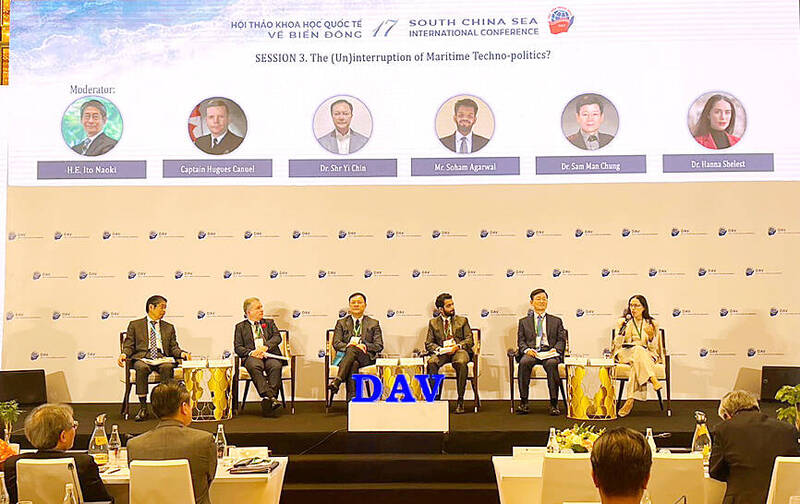
National Taiwan University professor Jin Shi-yi, third left, joins other panelists at the 17th South China Sea International Conference in Da Nang in an undated photograph. Photo coutesy of Jin Shi-yi via CNA
CALL FOR COLLABORATION: Other nations should study how Taipei and Manila resolved their differences after a deadly incident in 2013, a Philippine official said
By Jake Chung / Staff writer, and CNA
Participants at the 17th South China Sea Conference held in Da Nang, Vietnam, called on ASEAN to reduce its reliance on China, advance the globalization and institutionalization of the South China Sea issue, and support a global effort to maintain regional safety and stability.
The annual event, hosted by the Hanoi-based Diplomatic Academy of Vietnam on Monday and Tuesday, brought together policymakers, national defense officials and security policy experts from 40 countries.
Philippine Coast Guard Commodore Jay Tarriela said that other nations could take a page from how Taipei and Manila resolved their differences over a deadly incident in 2013 and signed the Agreement Concerning the Facilitation of Cooperation on Law Enforcement in Fisheries Matters in 2015.
On May 9, 2013, a Philippine Coast Guard vessel opened fire on a Pingtung County-based Taiwanese fishing boat, killing 65-year-old fisherman Hung Shih-cheng (洪石成) and injuring crew members.
German Ambassador to Vietnam Helga Margarete Barth quoted German Minister of Foreign Affairs Johann Wadephul as saying that “China’s increasingly aggressive behavior in the Taiwan Strait, and the East and South China seas also has implications for us in Europe. Fundamental principles of our global coexistence are at stake here.”
The standards for actions in the South China Sea should not be determined solely by China and ASEAN, and countries in other regions with interests in the sea should also devote more attention to the ASEAN Regional Forum and related activities, EU Ambassador to Vietnam Julien Guerrier said.
The international community must stand together to ensure that those who observe international law are rewarded, and those who contravene it are punished, Guerrier said.
Europe’s overreliance on Russia, the US and China should be a lesson for ASEAN, Guerrier said, adding that the bloc should develop strategic and economic autonomy.
National Taiwan University professor Jin Shi-yi (金士懿) said during the “(Un)interruption of Maritime Techno-politics” section of the forum that uncrewed platforms would redefine the future of scientific monitoring, search and rescue operations, maritime patrols and national defense.
However, the development of such systems also challenges existing international legal frameworks, Jin said.
Taiwan’s strength in artificial intelligence and semiconductor chip manufacturing, and its adherence to international law, show that it can contribute significantly to achieving the sustainable ocean goal, and to fostering peace and prosperity in the region, he said.
National Cheng Kung University academic Kuo Cheng-yuan (郭正元) presented research he conducted with Chen Tzong-yueh (陳宗嶽) on how the algae-bacterial symbiotic system helped sustain maritime biodiversity, and what challenges the Taiwanese and Vietnamese marine production sectors face when attempting to strike a balance between production and maintaining the ecosystem.
Taiwan has great technical innovation, and is among the leading nations in automation, biotech and renewable energy management, Kuo said.
The nation can play a key role in regional collaboration and maritime technology innovation, he added.
新聞來源:TAIPEI TIMES