離開
離開 進入
進入《TAIPEI TIMES》 Religious activities in China attract thousands
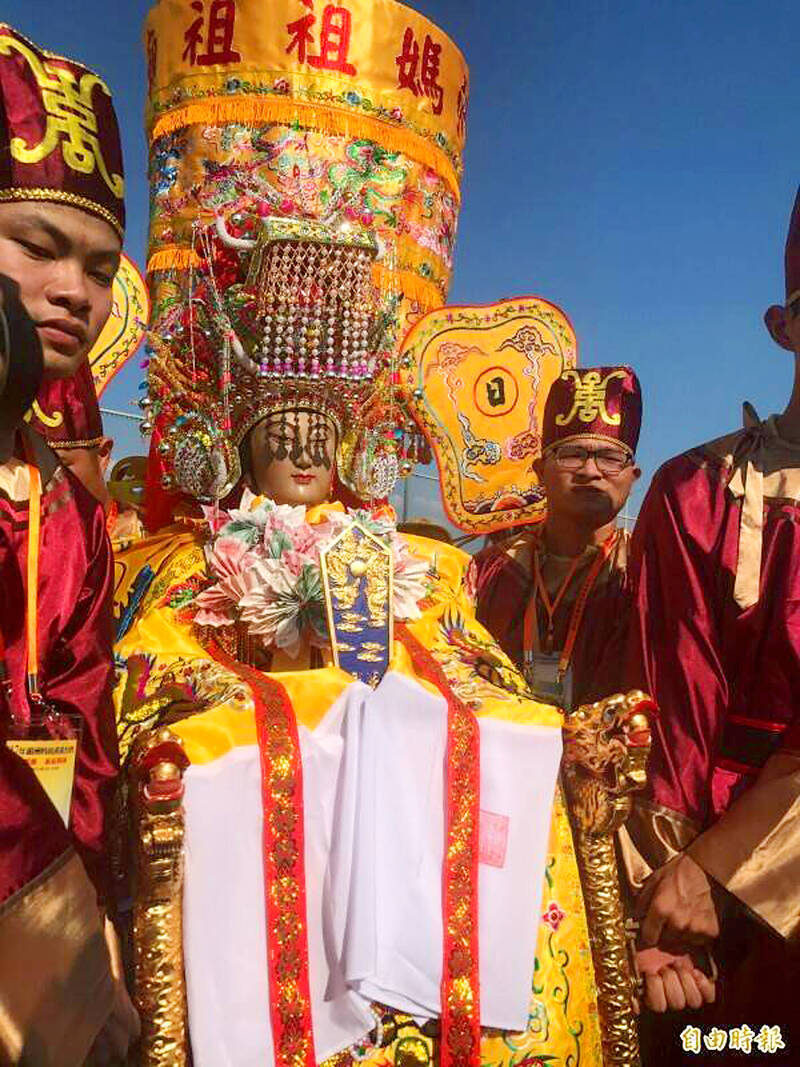
Men carry the statute of the goddess Matsu from Meizou Matsu Temple in China’s Fujian Province in an undated photograph. Photo: Chen Yu-fu, Taipei Times
By Yimou Lee / Reuters, TAIPEI
More than 10,000 Taiwanese participated in religious activities in China last year with support from the Chinese government, a study showed, which Taipei views as part of a campaign by Beijing to win hearts and minds.
China has long taken a carrot-and-stick approach to Taiwan, subjecting it to almost daily military drills while reaching out to those it believes are receptive to Beijing’s point of view.
Last year, 10,496 Taiwanese joined more than 110 religious trips to China, supported or organized by government units across China, according to the study by IORG, a Taiwan-based non-governmental organization.
IORG said the report, which was published late on Wednesday, revealed for the first time the scale of the Chinese campaign. Reuters has previously reported that China uses religion as a tool to influence elections in Taiwan.
China’s Taiwan Affairs Office did not immediately respond to requests for comment.
The Mainland Affairs Council yesterday said that Beijing has long used religion to conduct “united front” tactics targeting Taiwan, referring to a unit of the Chinese government tasked with bolstering Beijing’s reach abroad.
The government is closely monitoring the situation, the council said, adding that the IORG report held significant reference value.
Security officials are wary of what they see as a Beijing influence campaign using religions that are hugely important to Taiwanese life, but tightly controlled by the officially atheist ruling Chinese Communist Party.
China officially guarantees freedom of religion, but only under the leadership of the party.
IORG’s research analyzed more than 7,346 articles posted to a news portal run by China’s Taiwan Affairs Office. The articles offered details of events — including the scale, locations and agendas — and were examined by artificial intelligence-assisted tools before being verified by IORG researchers.
“The Chinese Communist Party continues to use religious exchanges as a cover for political propaganda,” the IORG report said, adding that the reviewed articles stressed narratives that the two sides share common roots and are destined to “reunify.”
In a report last week, the National Security Bureau warned that, under the guise of extensive “exchange programs,” Beijing was conducting operations to sway and infiltrate “all walks of life” in Taiwan.
“They use religious activities to win over the hearts and minds of the Taiwanese people, treating it as a political tool,” an official told Reuters.
The official requested anonymity due to the sensitivity of the matter.
The Mainland Affairs Council yesterday said that from Jan. 1 to Sept. 30 this year, it received reports of 212 cases involving Taiwanese who went missing, were detained for questioning or are suspected of having their personal freedom restricted in China. Among them, nine were members of the Taiwanese I-Kuan Tao (One Unity Sect).
新聞來源:TAIPEI TIMES