離開
離開 進入
進入《TAIPEI TIMES》DBS raises its Taiwan growth forecast
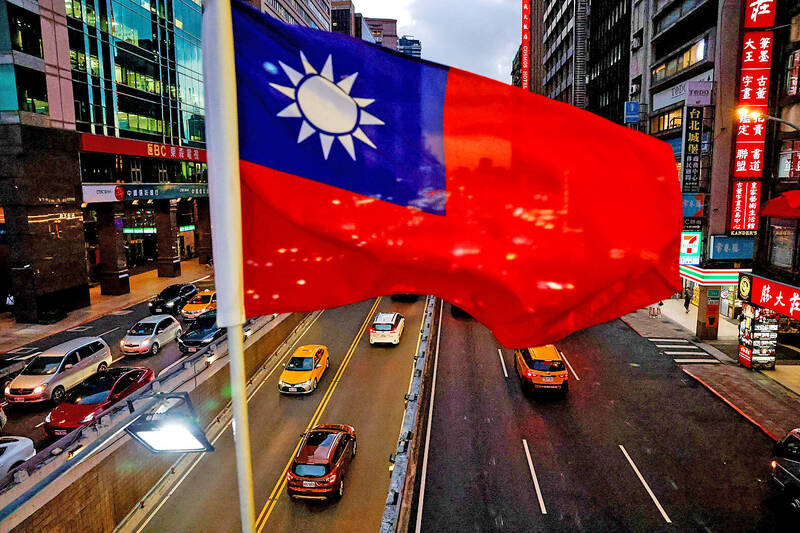
A Republic of China flag flutters on an overpass in Taipei on Oct. 8. Photo: Ann Wang, Reuters
AI BOOST:Although Taiwan’s reliance on Chinese rare earth elements is limited, it could face indirect impacts from supply issues and price volatility, an economist said
By Crystal Hsu / Staff reporter
DBS Bank Ltd (星展銀行) has sharply raised its forecast for Taiwan’s economic growth this year to 5.6 percent, citing stronger-than-expected exports and investment linked to artificial intelligence (AI), as it said that the current momentum could peak soon.
The acceleration of the global AI race has fueled a surge in Taiwan’s AI-related capital spending and exports of information and communications technology (ICT) products, which have been key drivers of growth this year.
“We have revised our GDP forecast for Taiwan upward to 5.6 percent from 4 percent, an upgrade that mainly reflects stronger-than-expected AI-related exports and investment in the third quarter,” the Singapore-based banks’ economist Ma Tieying (馬鐵英) said.
The economy expanded 6.7 percent year-on-year in the first half, with the information and electronics manufacturing sector contributing 6.1 percentage points, accounting for about 90 percent of total growth, the bank said.
While AI-driven demand remains solid, data suggest the sector’s rapid expansion might be losing steam, Ma said.
Exports of electronic components rose 25.6 percent year-on-year last month, compared with 34.6 percent in August, while ICT product exports surged 86.9 percent, easing from a 111.1 percent high in May.
The purchasing managers’ index for Taiwanese manufacturers has also stayed below the 50-point expansion threshold for three consecutive months, registering 48.8 last month, signaling a cooling trend.
DBS said it expects export and investment growth to moderate from this quarter into next year as AI-related demand peaks and the impact of new US tariffs begins to weigh on exports.
Beyond the technology sector, Taiwan’s broader economy is showing signs of strain, Ma said.
Non-ICT exports have contracted amid the US’ “reciprocal” tariffs introduced in August and weak demand from China, she said.
Domestic consumption remains sluggish as the labor market softens, with the number of furloughed workers increasing, she said.
Construction investment is also declining amid a correction in the housing market.
Real-estate loans account for 36.7 percent of total bank lending, above the central bank’s 35-to-36 percent target, leaving the monetary authority with little incentive to ease property loan curbs, Ma said.
Rising US-China trade tensions are further clouding the outlook. On Oct. 9, China expanded export controls on rare earth elements, and the next day, US President Donald Trump threatened to impose an additional 100 percent tariff on Chinese goods.
Rare earths are critical for semiconductor production, extreme ultraviolet lithography machines, and data center cooling systems. China controls about 60 percent of global mining output and 90 percent of refining capacity.
The new restrictions could delay shipments and raise costs across the global tech supply chain, DBS said.
Although Taiwan’s direct reliance on Chinese rare earth elements is limited, it could face indirect impacts from global supply bottlenecks and price volatility, Ma said.
DBS said it expected tariff-related risks to persist, with full tariff exemptions unlikely.
The government has proposed bilateral cooperation with Washington on industrial cluster development and infrastructure, along with enterprise-led investment and financial guarantees, to secure preferential treatment amid an ongoing US semiconductor trade probe.
新聞來源:TAIPEI TIMES