離開
離開 進入
進入《TAIPEI TIMES》 Taipei begins park renovations amid resident protests
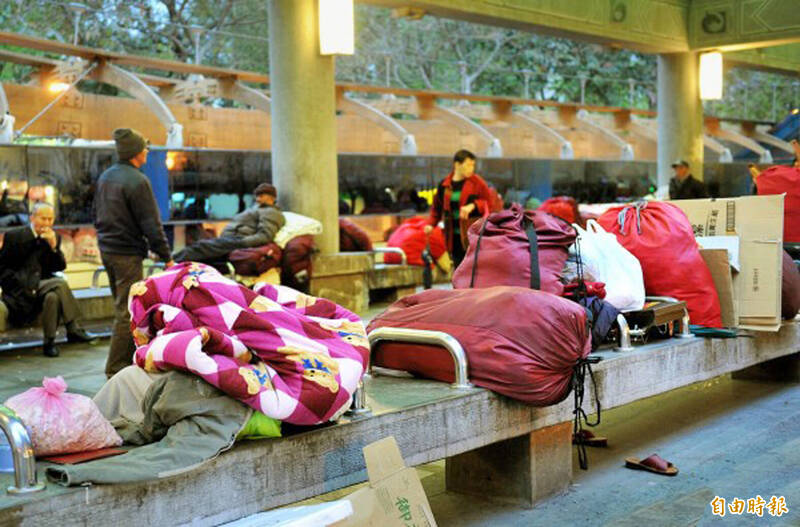
Belongings of homeless people are pictured at Bangka in Taipei’s Wanhua District in an undated photograph. Photo: Taipei Times
/ Staff writer, with CNA
A year-long renovation of Taipei’s Bangka Park (艋舺公園) began yesterday, as city workers fenced off the site and cleared out belongings left by homeless residents who had been living there.
Despite protests from displaced residents, a city official defended the government’s relocation efforts, saying transitional housing has been offered.
The renovation of the park in Taipei’s Wanhua District (萬華), near Longshan Temple (龍山寺), began at 9am yesterday, as about 20 homeless people packed their belongings and left after being asked to move by city personnel.
Among them was a 90-year-old woman surnamed Wang (王), who last week said that she had no plans to move into a government-run shelter, saying that “it’s less free in there.”
“My friend told me not to go... She said she ran away after staying for just a month,” Wang said.
“Some of the women there had mental health problems and would yell or scream late at night,” she added.
She said she opposed the renovation, but felt that homeless people “do not have the ability” to challenge the government’s decision.
The renovation of Bangka Park is the first large-scale project since it opened in January 2005, said Wang Su-ya (王淑雅), head of the Parks and Street Lights Office’s Youth Park Management Division.
The renovation was triggered by the park’s deteriorating facilities and community requests for improvements, Wang Su-ya said.
Chiu Ching-shung (邱慶雄), head of the Department of Social Welfare’s Division of Social Work, said that as of Monday, about a dozen of the 59 registered homeless residents of Bangka Park had yet to be resettled.
Those who decline help would likely move to Taipei Railway Station or Ximending (西門町) — areas where homeless people often congregate, Chiu said.
Addressing concerns about transitional shelters, Chiu said they serve a greater purpose than just providing a place to stay by helping people reintegrate into society.
“We hope residents can change habits that contributed to their homelessness during their stay at transitional shelters,” Chiu said.
“Transitional shelters are not suitable for everyone,” he said. “But we’re open to suggestions, including making the rules more flexible.”
Another option — temporary overnight centers — offers a short-term stay with “almost no rules,” but only basic sleeping space, showers, laundry facilities and simple breakfasts, Chiu said.
新聞來源:TAIPEI TIMES