離開
 進入
《TAIPEI TIMES》 Taipei still has leverage with US, researcher says
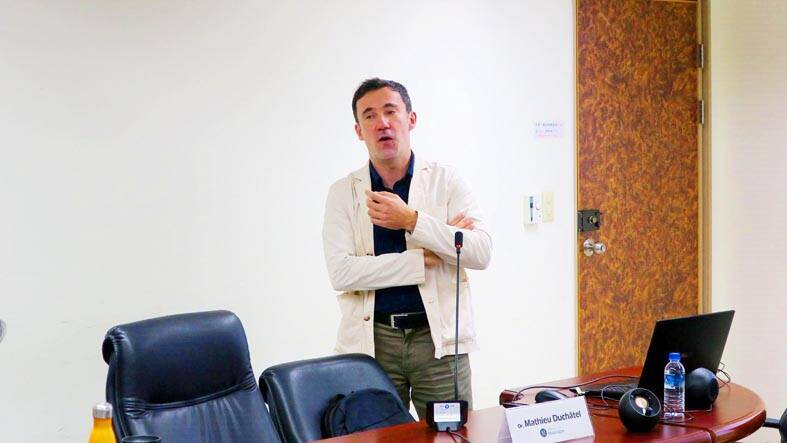
Mathieu Duchatel, Asia Program director at the Paris-based think tank Institut Montaigne, gives a lecture at National Cheng Chi University’s College of International Affairs in Taipei on May 14 last year. Photo: courtesy of National Cheng Chi University’s College of International Affairs
BARGAINING POWER: Taiwan’s chip dominance and its role in strategic competition between the US and China mean it still ‘has cards to deal,’ an expert said
/ Staff writer, with CNA
A French researcher on Monday said that the US is taking a confrontational stance against China, which would maintain Taiwan’s leverage in negotiating with Washington.
Mathieu Duchatel, Asia Program director at the Paris-based think tank Institut Montaigne, said that while US President Donald Trump occasionally discusses trade with China or regional spheres of influence, the White House’s economic security measures emphasize an oppositional stance on Beijing.
For example, the America First Investment Policy signed last month states that the US would “use all necessary legal instruments,” including the US Committee on Foreign Investment in the US, to restrict China’s investment in strategic sectors, Duchatel said.
The US government has also showed hostility against China in semiconductors, he added.
While Taiwan’s democratic values are insignificant to Trump’s “America First” policy, it is still important to the international community, Duchatel said.
However, Taiwan still “has cards to deal” when it comes to semiconductors, as the US needs more high-end chips, he said.
A second bargaining chip is Taiwan’s role in the competition between the US and China, as signs indicate that the competition would continue and constitute a main pillar of US foreign policy, he said.
Taiwan can also play a part in defense collaborations against the Chinese People’s Liberation Army, with interests aligned with the US, he added.
“Beijing is avoiding heating up while showing that they have new options to respond, such as strategic export restrictions, to convey that they are preparing for conflict” in the face of tough US trade and tariff measures, Duchatel said.
The US and China are willing to negotiate on economic issues, but it is unclear whether allies of the US, such as Canada and Australia, would join in a trade war with China.
“It seems that Mexico is ready to do this,” he said. “This will cause some problems for China.”
Although Taiwanese companies’ monopoly on cutting-edge chips would likely not be threatened by a trade war, its market share for ordinary chips might be affected, Duchatel said.
However, Taipei is aligning its geo-economic strategy with the US and diversifying collaborative partners, he added.
The most influential discourse on US policies on Taiwan is the “strategy of denial” proposed by US undersecretary of defense for policy nominee Elbridge Colby, Duchatel said.
Colby’s strategy aims to deter China before a conflict breaks out and deny it victory in Taiwan.
Regarding concerns that the US appears to be siding with Russia and moving away from Europe, which might embolden China to invade Taiwan, Duchatel said it is certainly the worst risk.
However, he questioned whether it was beneficial for the US to cut ties with Europe.
“Could the US just be requesting that Europe share safety responsibilities to concentrate its energy on China?” he said.
China could not jump to the conclusion that it is safe to invade Taiwan, he added.
The circumstances in which the war in Ukraine ends would be a revelation to Taiwan on whether the US would abandon its allies, he said.
Building up Taiwan’s military power would also be a key bargaining chip in negotiations between Taipei and Washington, Duchatel said.
He said that Taiwan should push for collaboration with the US on defense and technology, fields that would inevitably have a decisive influence on Taiwan.
新聞來源:TAIPEI TIMES