離開
 進入
《TAIPEI TIMES》 Act to regulate the use of regenerative medicine
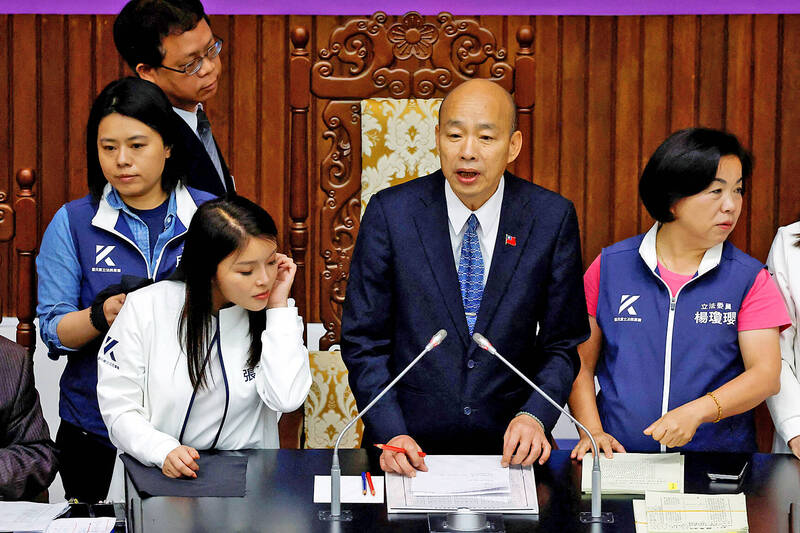
Legislative Speaker Han Kuo-yu speaks during a session at the Legisaltive Yuan in Taipei yesterday. Photo: Carlos Garcia Rawlins, Reuters
By Lin Hsin-han and Jake Chung / Staff reporter, with staff writer
Non-medical facilities would no longer be allowed to offer regenerative medicine treatments, and while all regenerative medicine must undergo human trials, the requirement could be conditionally waived for compassionate use, if the legislature passed the Regenerative Medicine Act (再生醫療法) as expected last night.
The human trial requirement would be waived for regenerative medicine uses approved by the central government, the draft states.
Competent authorities would draft and announce conditions for the compassionate use of regenerative medicine, the application process, restrictions on the number of applications allowed, and moral regulations on regenerative medicine, it says.
However, treatments for compassionate use cannot use cells or matter from other animals or sources, the draft says.
If passed, the act would formally make the Guide on Moral Policies Involving Human Embryo and Embryonic Stem Cell Research (人類胚胎及胚胎幹細胞研究倫理政策指引) legal.
Under the guide, artificial insemination to create embryos would not be allowed for regenerative medicine research involving embryos or embryonic stem cells.
The guide also bans the creation of hybrids or inserting cell nuclei from other animals or species into enucleated human oocytes, the mass production of embryonic stem cells for research, and creating or propagating chimeric species containing human reproductive cells.
The draft act says that non-medical facilities practicing regenerative medicine, or advertising regenerative medicine services, face a fine of NT$2 million to NT$20 million (US$62,174 to US$621,736).
Those using a regenerative medicine treatment that has not undergone human trials would also be fined NT$200,000 to NT$2 million.
Separately, if amendments to the Regulations on Allowances for Elected Representatives and Subsidies for Village Wardens (地方民意代表費用支給及村里長事務補助費補助條例) passed a third reading, then the monthly subsidy for assistants to NT$320,000 for city and county councilors in municipalities and NT$160,000 for those outside of municipalities would be raised.
新聞來源:TAIPEI TIMES