離開
 進入
《TAIPEI TIMES》 Taipei vows to avoid devices from insecure source
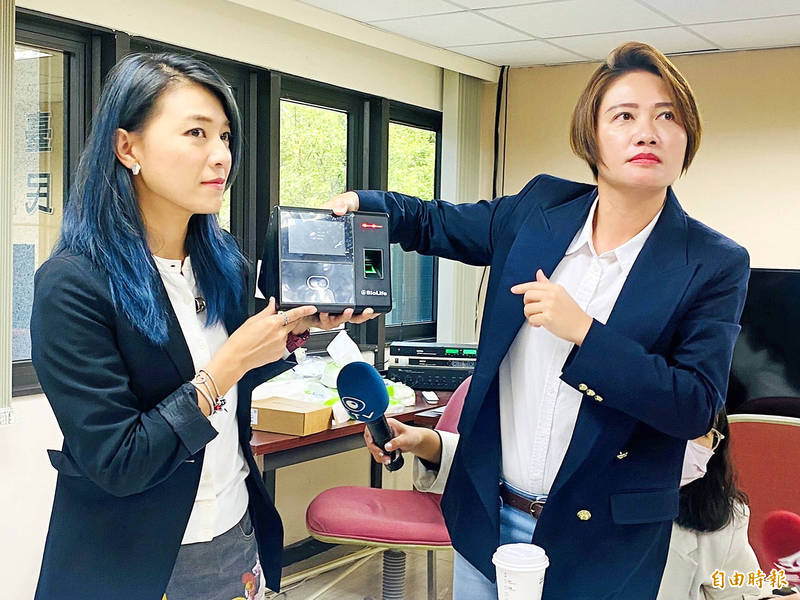
Taipei city councilors Lin Yen-feng, right, and Yen Juo-fang showcase a biometric attendance machine at the city council yesterday. Photo: Yang Hsin-hui, Taipei Times
THREAT: A probe was launched, as city councilors alleged municipal offices bought Chinese-made devices with facial recognition and fingerprint collecting capabilities
By Wang Chien-hao and Jonathan Chin / Staff reporter, with staff writer
The Taipei City Government yesterday vowed to ensure all municipal devices are provided by secure sources, after city councilors alleged that 19 municipal offices used attendance machines which were made or assembled in China and Thailand, and had fingerprint collection and facial recognition capabilities.
Eight agencies procured Chinese-made machines, while 11 agencies bought machines that were assembled in Thailand, but are mainly made of components produced in China, Democratic Progressive Party (DPP) Taipei City Councilor Lin Yen-feng (林延鳳) told a news conference at Taipei City Hall.
The city’s use of those attendance machines is a breach of the cybersecurity guidelines issued by the central government, she said, adding that the Thai machines were on a blacklist on the National Communications Commission’s Web site.
Forty Taipei City Government offices and agencies bought new biometric attendance machines after the municipality ordered measures to be taken to stop city employees from cheating by having colleagues clock in for them, she added.
Although the municipal government said the machines were connected to the agencies’ internal network and likely did not pose a cybersecurity threat, Lin said she disagreed with this assessment.
The central government’s guidelines had urged public bureaucratic organizations to be cautious when ordering digital products and services, she added.
The failure of the Taipei City Government to follow cybersecurity standards called into question the security of city residents’ personal information in municipal systems, DPP Taipei City Councilor Yen Juo-fang (顏若芳) said.
The city’s procurement process must be reviewed to weed out Chinese-made technology products assembled in a third country and all biometric attendance systems should be checked for their place of origin, Yen said.
A representative of the Taipei Department of Information Technology at the news conference did not dispute the city councilor’s allegations.
The agency would intensify its efforts on supervising city offices’ compliance with regulations, the representative said.
City agencies would submit all procurement plans to the department for evaluation and approval to help avoid the problem, they added.
A representative of the Taipei Public Works Department said the machines might have slipped through the cracks, as the city government did not require subordinate offices to write contracts for small-volume purchases.
The Taipei Department of Information Technology is launching a probe into any potential harm to cybersecurity caused by the attendance machines, department commissioner Chao Shih-lung (趙式隆) said.
新聞來源:TAIPEI TIMES